Sunday, December 8, 2013

Star Wars KOTOR II Playthrough Pt 0 - Preface

Not sure why I decided to do this, but what the hell, I've recently acquired KOTOR II in a Steam sale since I've had a huge lust for Star Wars lately. And, with that, I found I have a lot to say about the creation and substance of KOTOR I and KOTOR II, so I'm going to embark on a long, segmented chronicle of my journey playing through it.


This is Part 0 because it's not really a chronicle of the experience as much as a few short words to detail my experience and what I'm going in with.

For starters, it's one of the internet's most common knowledge that there were huge chunks of this game completely gutted for a last-minute rush to the Christmas deadline. For more, I turn to you with a Kotaku article:

Although KOTOR II was released in December 2004, it was never quite finished. Deadline restrictions forced Obsidian to remove a great deal of content—planets, scenes, and plot points were all left on the cutting room floor. Crafty modders would later find and restore this content, as Obsidian left it in the game's source code, but back in 2004, it was all just scrapped.
So why was it all cut? 
"What happened was—and as a lot of these things happen, no one means anything nefarious, no one means anything badly or anything like that—what happened was we were on the track to get done for Christmas, and the game was looking really good," Urquhart told me. "I think there was some surprise within LucasArts that we were doing as good a job as we were. I think there were some parts of LucasArts that were worried that ‘Oh, this new developer and they're gonna fuck it up like all new developers fuck everything up.'
"And so in early 2004 they took a look and they were like, ‘Wow!' Their QA was playing it, and they were like, ‘This has a lot of potential: let's move it out, let's give it time.' So they moved it out to the next year." 
Urquhart was perfectly fine with that decision, and he changed the project's schedule to reflect that new 2005 release date. But he forgot the cardinal rule of dealing with executives: make sure everything's in writing. 
"On our side we didn't make sure that we had the contract changed," Urquhart said. "And then post-E3 I think financially something happened—I don't know what it was. And we got the call and they said it has to be done for Christmas... Again, I don't think this is anything nefarious, it just happened. Some of the onus is on us: we didn't get the contract changed. So we had to make this decision: get in trouble or get it done."
Yeesh, talk about hindsight. It kills me thinking what this game could have had in it if Obsidian got to do whatever they wanted. And so, according with what the game was Supposed To Be, I'm going pretty barebones with minor exception of The Sith Lords Restored Content Mod, a few texture packs, a Widescreen mod, and a mod that makes the lightsabers light flicker look like the one from the old movies (I'm a purist).

EDIT: A complete list of mods that work with TSLRCM can be located here. The lightsaber mod I mentioned I believe I found here. (It's hard to remember).

Additionally, now is a good time to talk about the original KOTOR - to be honest, it's not great. The amount of critical acclaim it received might have been overwhelming at the time, but Attack of the Stupid Name had come out just one year before, and, well, beggars can't be choosers. This phenomenon would be repeated a few years later with Revenge of the Sith being not offensively terrible and therefore gaining 80% on Rotten Tomatoes, despite the terrible dialogue and being directed by George Lucas.

I can't speak for certain but maybe the writers at Bioware had been conditioned on some kind of volunteer Clockwork Orange procedure and thought that campy, corny dialogue was some sort of Star Wars staple. Sure, Han Solo yelling about "the way you feel about me" wasn't romantic gold, but at least it didn't involve Clark-Gable-written-by-idiots lines like, "Shut up and kiss me, you babbling fool!" Tycho of Penny Arcade (yes, I know, but listen first) once called it "a bad game with one really great plot twist," which I feel is an accurate assessment of what the game is today. The combat animations are choppy and break, the combat's kind of boring, the plot is kind of silly, the dialogue is corny, there's no real 'life' to the game beyond watching talking heads, but overall it was just a good game that didn't age especially well.

Age was one of the main things that made me not want to play this game - a game I thought looked okay on the original Xbox, even if I downscale my expectations and go into a decade in the past, is going to look like garbage today. And what kind of old-game bullshit is it going to pull? I still remember getting frustrated and quitting Bioware games only a few years old for a lack of appropriate autosave.

Speaking of which, my experience with this game is limited. I remember a few bits and details, but I never finished my original Xbox version when it first came out due to, well, fairly obvious reasons - not only was the game horrendously buggy and kept crashing and breaking on me, the game's frustrating missing content was agonizing. Watching quests literally just end for no reason and doors that are supposed to be open go "nope!" was the most frustrating thing, and between the two I just dropped off after a few hours.

I'm still familiar with a decent chunk of the plot, but it's all foggy and I'm kind of excited to play this game for the first time - or at least enough of a 'first time' that I will be surprised by sequences.

And, lastly, if you haven't yet, the first two volumes of the Star Wars: Knights of the Old Republic comic are completely fantastic, at least before they completely changed creative teams and the series underwent a dramatic shift for no reason. It, as well as this, are the main reasons I love the KOTOR universe. It's a universe where huge chunks of it have nothing happening, and there's infinite canvas to paint upon. 

Tuesday, April 9, 2013

Bioshock Infinite Sorta-Review


Bioshock Infinite is a good game. I'm just going to say that because I feel like if I don't hang that disclaimer up, I'm going to have rocks thrown through my windows by the time this hits publish. Because as much as it's a good game, as much as it has a lot of really interesting ideas and tends to snowball you with a lot of sights and sounds, I am really, really let down by it.

At first I felt like I had the issue of overfamiliarity. Instead of being in an underwater city full of magic powers and gunplay where the protagonist, bad guy, and support character are not quite what they seem, I was in a skyborn city full of magic powers and gunplay where the protagonist, bad guy, and support character are not quite what they seem. But let's be slightly more fair to it and Ken Levine – we are, after all, not playing Space Marine Wacky Adventures. Bioshock is in the title, and perhaps these things all come with the territory of being a Bioshock game, in the same way that Tomb Raider is inevitably about Lara Croft climbing and shooting.

But even then, Bioshock was a landmark because everything just worked. Anything that was in the game had a reason – the science-softening microwave in the form of ADAM allowed the rest of the game room to work, and everything that surrounded it tied into the central theme. Ryan's objectivism built a house in which genetic modification could flourish, but it inevitably collapsed as the abuse ran rampant, and Big Daddies served as both an ADAM tool in-game, a service in the game's world, and a metaphor for the downfall of Rapture.

Meanwhile, the equivalent to the Big Daddies in Infinite are giant clockwork robots with gatling guns that spout patriot mantra. Subtlety? Bioshock Infinite seems to say, What's that? If you didn't like our robot soldiers, try our blue-robed racist KKK knockoffs who worship John Wilkes Booth as though he were a golden idol for his work assassinating Lincoln.


It's like the creators never even played Bioshock – all sense of subtlety and world building feels like it's been dropped in favor of more gunplay and big dramatic events. Elizabeth's powers don't even really have much of an explanation that feels in line with Bioshock, almost as though they weren't sure how to explain it, so they just gave up. The presence of ADAM in Bio allowed for the existence of Plasmids. And in Infinite, there are Vigors, which allows the same effect. Now, how did Vigors get created? Well, good question, one that seems more an afterthought than anything, like they saw Elizabeth's powers that they didn't explain thoroughly and went, “YES! A loophole!”

Being fair, maybe the lack of subtlety was the point. After all, Rapture was about the power of the individual rising above, and that probably sounds pretty good if you're fourteen years old, so I can understand how it would come about there. But Colombia draws a sharp contrast by being upfront about its horribleness and how completely awful the entire two-thirds and slavery laws were. For that, in fact, I have to commend it – the barbaric way I ripped a man's throat out, after the drawn out intro of colorful utopia, honestly surprised me, and being shocked by Bioshock turning horrifically violent is like being surprised when Superman saves Lois Lane. It's no shocker this trauma only happens after you're asked to, well, stone an interracial couple to death. It is, no joke, one of the best moments in the game, and it's the first hour of gameplay.

And yet, when you get down underneath the polished presentation, the game feels a bit erratic in its focus. Bioshock, at its core, was about the folly of Randian objectivism. What is Infinite about? American exceptionalism, sure, but you don't have to dig very deep to find out that racism is bad, and then the black lady rebel leader turns out to be completely insane and homicidal (which tends to be a pretty significant issue), in which case so much for that. Is it about power corrupting? I can't tell, because after that the entire political conflict is dropped and it hopes you forget in the rush to find out what's behind all the mysteries. The end story is wrapped up well, but I find myself wondering what I was supposed to take from it. Was the theme of the story just set dressing, not really meant to be played with conceptually?

Daniel Joseph says that it's all about extremes at war, and how the middle – the working class – don't care about the conflict because they want stability, but (and I say that with full respects to Joseph) I don't agree because it feels more of a biproduct of the game's creation than its real point. Levine said from the beginning he was inspired by the Occupy protests and the Tea Party, but politically neither of them are as mercilessly evil like Comstock, nor are they as psychotic and bloodthirsty as Daisy Fitzroy. What, precisely, is Infinite's stance on this political agenda?

In the end, all I see Infinite telling me is, “Both sides are wrong.” I saw the post-rebellion civillians of Colombia evacuating for about ten seconds, and Booker mentioned offhandedly they were going “anywhere the Vox aren't,” and after that, the game barely mentions it, not even when the civil war has torn the city apart.

There are buckets of issues with making jingoism, xenophobia, and religion the focus of a villain. There are two sets of buckets of making the lady of color and revolutionary just as crazy and psychotic as the villain. But to introduce that everyone and everything sucks, then simply drop the issue and speak no more of it? A lesson or moral that 'Everything sucks, the end' is a shitty, lazy message, and I really expected more from the brain behind Bioshock, especially going in when he promised that he saw inspiration from hot-button topics of the period. Racism and oppression of the underprivileged are issues today, not just in 1915.

On the bright side, the game probably steals all of the awards ever for Elizabeth, who is probably one of the best sidekicks in gaming in recent memory, and not for the reasons you figure. Sure, she can summon objects as per her realitywarp powers, she tosses you fully loaded guns (so long as we're on about gameplay, that's a nice perk), and that's all well and good, but at her best, she's just a fun character.


At first glance, she seems to be set up to be a quirky maniac-pixie dream girl, replacing romance with a touch of parental care on the part of Booker, and while that turned out to be entirely the case, Elizabeth is everything I ask for in noncombat lady characters – she's determined, complex, shows surprising strength, independent, a lot of fun, and imaginative. There's none of the dainty frailness of a princess in a castle, Elizabeth is a fully realized character, and every moment of ambiguous morals, flaws, aspirations, talents, trappings, and growth all fit to her personality. When she sobs into her hands and lures Booker close enough to club him in the head with a wrench to commandeer the vessel, it makes her genuine moments of vulnerability (with Songbird, or when she attacks Fitzroy) so much more vibrant. Her moments of naiivity early on are endearing, but when her one ally (Booker) turns on her, she becomes cynical and distrustful. She's a complete character, top to bottom.

For what it's worth, the combat of Infinite is just fine for a shooter. The problem is, much like the rest of the game, I genuinely wonder how we got a Bioshock game that plays like this. Scavenging has been a core component since System Shock 2, but now it's been cut down to streamline everything into more gunfights. I feel like there's a bit of a chicken-or-egg situation here; did the lowering of stat adjustments on food render the Take button obsolete, or did they find the game more fun to just Take All at every turn so they lowered the food penalties to make it less frustrating? I can only imagine the next Bioshock game removes food entirely and just has you running over bodies to retrieve ammo.


It seems obvious at first to remove all the side content to Bioshock – like the hacking minigame, among others – to turn everything into either powers or gunplay, but the contrast of doing six different things at once made the hectic and panicky gameplay and dense atmosphere totally enjoyable. Walk through tunnels hearing 60s tunes, see a wandering Big Daddy and Little Sister, get into a gunfight with a group of Splicers, barely scrape your way through, hack a vending machine for lowered prices, get into a conversation with a crazy person.

Instead, Infinite is just a conga line of gunfights cut up with interesting story segments, and the spice has all left. There's optional quests that involve finding keys and going back to the last area and using it on a door you couldn't enter, but it feels like an afterthought, like the sandboxy world from Bio is just gone. Colombia never felt like a big city – it felt like Afghanistan in the clouds, a string of shooter setpieces I adventured to with some nice setdressing. It's just gunfights and magic powers and gun upgrades. Bioshock is now the Bioshock knockoff, in that way, like Singularity before it, even in the specific way it uses puppet shows in place of the drive-in movie advertisements.

The gun-upgrading is still there, but since you're only allowed two guns at a time and have to constantly swap out weapons, each upgrade loses meaning as you frequently have to discard your six-upgrades machine gun and shotgun after running out of ammo. You're never allowed to prefer a gun because of how frantically you have to keep swapping weapons. And there's such a ridiculous amount of guns, the upgrades feel vestigal at best. Remember when the hectic and panicky combat of Bioshock demanded upgrades to keep any level of edge over your opponents? Where is that now?

Why is the hostility of the environment not creating a sense of oppression and terror rather than just making the game into a shooting gallery where I sometimes summon turrets or possess turrets or shoot fireballs? Why is a Bioshock game repeating half of the core mechanics then applying them to a new system? The skyline is there, sure, but in a different game the entire mechanic would have had the whole game built around it.

Are we just doomed to cut down every aspect of an interesting RPG/action game in favor of streamlining the gunplay and turning every game into Call of Duty? Is this really what we want, deleting features instead of adding or improving to them? 

It's kind of relieving to see the reception first overwhelmingly positive then, after a spell, collect their thoughts and step away. It's important to try to go in unbiased, and I can understand the difficulty of doing that with a game carrying the Bioshock torch. And I'm really glad. Because as great as the game is - and it is great - the seams where one game became another are showing. And I really want to see the other game more.

Friday, December 28, 2012

I Really Don't Like The Adventure Time Game

WayForward, you have let me down.

The Adventure Time game, on first glance, practically screamed things I would appreciate. I felt like the last fan of Zelda II in the world, and here was one that was embraced by hands-down my favorite cartoon ever, Adventure Time. How could this go wrong? Beautifully drawn sprites, kickin' music, and a plot that would crack me up.

I don't think it did any of these right.

Core combat felt annoying from the get go, by forcing me to use bareknuckles to fight with. With an absurdly short range, I slipped frequently into enemies, taking more damage and occasionally knocking me into the too-frequent pits scattered everywhere about. Thank god, I finally got Scarlett, Finn's sword, which gave me bonus range, but only provided I had more than one heart (four hits). Which makes a lot of sense, right? Only after you take a lot of damage do you lose your ability to attack from safety.

The annoyance of the clunky and frustrating combat is assuaged by a plentiful amount of healing items, but they're dropped at an absurd rate. After a few combats, you've got more apples than a produce store, and the less-useless powerups go unused as you tank-and-potion your way through. There's a pseudo Earthbound-like aspect of combining condiments with food, but neither is especially useful, convenient, or interesting. Earthbound did the same thing over a decade ago, and it was automatic and fit with the RPG system. AT does neither of these things.

I could forgive annoying combat with a stronger compilation of features, but HIKWYSOG borrows all of the worst aspects of Zelda II and removes all of the compelling points. There's overworld random encounters, but you can't run from them, there is no experience or level progression to grind, and all they do is give you more items, clogging your inventory with a needless amount. Every important landmark has a small level between it, but the quests in this game are aimed almost entirely at the 'fetch' variety.

In every zone you have to run errands before you can enter the dungeon, and not in a fun way, but in an obnoxious way. Collect three of something by talking to famous Adventure Time cast members, then run around and talk to someone they tell you to talk to. Talk to Lemongrab, talk to the three people in the area, talk to the Gravedigger, talk to the Nut King, talk to Mr. Bank...by the time you're done, you've given up on genuinely fighting the enemies before you instead of jumping over them or running past. There is no fast travel at all. You have to run everywhere. There's a map, but it tells you only that there are landmarks there, not what they are or even where travel locations are.

With the 2d combat, the dungeons had a lot of things they could play with, but there's practically nothing there. Most of the dungeons can be cleared in about ten minutes, none of the bosses are especially creative, and it's not so much a 'puzzle' as it is 'hit button, return to previous room.'

Again, all of these things could be forgiven for being a huge chore, but the writing just is...lacking. Not only does it feel oddly out of place compared to Adventure Time, there's no writing charm either. None of the gags made me crack up laughing like the show frequently does, instead most of them are just kind of cute. They also have this odd habit of making a storyline reason for Jake to learn a power, but Finn learns something like the downthrust (Zelda II, again) out of opening a chest. The consistency from the show vanished.

Additionally, the lengths the game goes to put characters into the game starts to have serious dissonance with the show to anyone, not just the hardcore. The most egregious example of this is Earl of Lemongrab - in the show, there's no episode where he shows up that people like him. He only takes over after Princess Bubblegum no longer can be the Princess. So then why does she offhandedly mention that Lemongrab is running the investigation? And further, the bad guy is the Ice King, but he's been in the same category as Bowser as 'humorous once-bad guy turned mild annoyance,' so how am I expected to take him seriously as a villain? And why are Finn and Jake trying to fight him about their garbage? They handwave it as 'It's Adventure Time', but it feels out of place with the writing really missing the AT justifications. I don't understand how Pendelton Ward could have participated in this when they're so haphazard with the canon.

The game just feels so soulless, in every way. The visuals are nice, even if many events happen with a fade-out-fade-in rather than an animation, and the music is great, but everything else just misses the mark. The combat is boring, the dungeons are brainless, the writing can't even make you smile, the plot is threadbare, and the tenuous connections to the show barely exist.

It feels like this was not a labor of love from WayFoward, but instead from their publisher at Cartoon Network Interactive. As though the game was a product that a machine turned out after the entire series and a cartridge of Zelda II was dumped into it - wearing a mask, waving its wobbly arms, spouting "butts" and "mathematical!", begging you to mistake it for the real thing. No love was put into the game, and it shows horribly. I was hoping something with this much potential would be impressive, but it fails in every way it can.

Saturday, December 1, 2012

Killing is Harmless Pseudo-Review

When Fight Club landed in 1999, it was glanced over, dismissed by reviewers, and overall mostly ignored as a confusing mess of a movie. But it resonated with a very large group of moviegoers - since then, it's become a cornerstone of that time period, something that touched a very raw nerve with the men of the 90s. It dealt with a lot of very touchy issues and, perhaps more importantly, never specifically said if they were right or wrong, just that some people handled it in different ways. Many critics who hated the movie called it 'facist', among other things, critically missing the point (in my opinion anyway, as one of those people who was strongly affected by the film).

The videogame industry has been riding the coattails of the immensely successful modern military shooter for what feels like forever. What is about five years in game industry years? It feels like twice that. And now, when all but the diehards have just about gotten exhausted of the genre, we have the video game industry's Fight Club. An intense, uncomfortable, shocking, raw, disruptive game that doesn't gut the tropes we have gotten used to, as much as it exposes them, asks questions, then walks away and leaves them to you.

And, similarly, there is a strong negativity to the game - calling it hypocritical for its dissonant 'a shooter that hates the genre,' or even just dismissing it as 'just a shooter'. With the utmost respect, I can't describe how much I disagree. Spec Ops, to me, is a very important game (the details of my experience I still have yet to publish here). It's a game that speaks to me as someone who liked all the Modern Warfare games, who has grown a bit tired of the military shooters, and puts a very scary, humanizing spin on it. It's not just the big moment that everyone gets surprised by - it's the hallucinations, the disorienting amount of plot shifts, the constant sensation of 'this is wrong,' the fact that by the end, you hate Walker for everything he made you do. For me, it's not even a shooter - it's a horror game, one that suckers you into thinking it's a Call of Duty clone before yanking the mask off.

So what would happen if you had someone who was strongly affected by the game sit down and analyze literally everything in it? You get Killing is Harmless, by Brendan Keogh.

I'm going to just warn from the getgo that this is not the book for everyone. In fact, if you don't know what Spec Ops even is, and are uninterested from the description I just gave you, I don't even think you'll get anything out of it. But, if you played and were as deeply shaken by it as I was, or even just are curious why so many people were so strongly affected, this is worth your $3.

The strengths are obvious - Brendan is a talented writer, and he was deeply shaken by Spec Ops. It's a match made in heaven to have him write a novel-length analysis about everything that is this game. And he's not the kind of person like Yahtzee who has a long, deep-seated hatred of military shooters. Brendan speaks as someone who gleefully loved Modern Warfare 3, even when (in his own words) he had no idea why. His turn of phrase is always entertaining and engaging, and he breaks up the reading of Spec Ops with frequent (but very relevant) asides and comments on similar events, or notes how infrequently other games have events such as the primary characters cracking under pressure and begin infighting.

He occasionally resorts to over-repetition when returning to advancing the game ("Moving on," "We approach..." "We continue..." "We enter..."), but these are minor nitpicks. His writing style is always entertaining and stays focused enough to get the important message home without tiring you of the topic. Almost all of Chapter Eight is discussion about the white phosphorous strike, but it is smartly structured and never feels over long.

Brendan's book is to 'analyze everything' in Spec Ops, and 'analyze everything' he does, even a stop sign at the very beginning and Walker's own name are both foreboding and ominous. That is, honestly, the thing that will drive some people away from Killing is Harmless. Extra Credits said, in their two-parter, that some of the plot structure, fourth wall breaking, and psychological aspects will pull many people out of Spec Ops, as their suspension of disbelief is broken. Brendan, however, seems to revel in it, even when he otherwise shouldn't. Darius Kazemi's review most strongly criticizes this, with a moment where Radioman blames all the violence on video games, and Brendan admits it's unfunny and forced, yet approves of it for being right.

And yet, it's very difficult to feel like the book is worse off for it. Sure, I don't agree that the crows are symbolic, I don't agree that the stop sign is that important, and there's plenty of times where I thought to myself, "You're overreading a bit here, Brendan." But I can't bring myself to dislike the book. It is, at its core, an analysis both on the game, and the man Brendan himself. It's even in the foreward - "Ultimately, this is an act of interpretation." He wants you to understand what he has interpreted from Spec Ops.

I would not consider a reading of Fight Club bad if it makes a lot of statements and suggests things about the movie I do not disagree with. Even the director said in the commentary, "You'll notice how Tyler says the same thing as the therapist earlier in the movie, 'I look around and I see a lot of men...', etc." I didn't think there was anything to that, except maybe that a script/screenplay writer's style of speech coming through. Would I like the movie less now knowing that? Or any of the actors? Or any other writer? Not at all. Fight Club asked a lot of questions, and gave you very little answers. It played with the concepts of nihilism and anti-consumerism, then simply ended the movie. Was Tyler evil? Was the narrator? Maybe, but maybe not. Similarly, Spec Ops is not interested in telling you the answer - it wants to ask you questions it does not have an answer for. Killing is Harmless is Brendan's book about his answers, not everyone's.

Killing is Harmless had a goal of critcally reading Spec Ops, top to bottom. And that's what it did - even when I disagree, it helped me (as it may help you) to understand the game itself more. Even when the book is overreaching or wrong in whatever he has conceived, even when it misses things I believe (such as how Extra Credits says it used the aged gunplay to give the player a sense of 'wrongness' early on), even when the book is probably just objectively wrong, and you will find these moments....Brendan was successful in his goal.

Wednesday, November 28, 2012

Short Thing On #1reasonwhy


Have you seen this woman? 

This is Jade Raymond, and during 2006-2007, she was everywhere, promoting Assassin's Creed, of which she was a producer at Ubisoft. At the time, she was 32, a grown woman, a graduate of Marianopolis College and McGill University's computer science program, a veteran from Sony Online's first R+D group, a producer on The Sims Online, and an enthusiastic gamer and game developer. 

Jade is very devoted to her work, and any interview you find from that time will usually feature her talking about Assassin's Creed, but not just in terms of play, but AI, world building, historical accuracy, and the like. Did Ubisoft put her out there because she is a very attractive lady, or because she knew the most about their product? Was it because Assassin's Creed was her creation or idea? Or was it because she was the best PR face they had on hand? Nobody really knows. But she was always there, doing interviews, giving presentations, sneak peeks, hands-on demos. 

But the games press five years ago was even more stupid than it can be today. A rumor started of her posing for Maxim magazine. Kotaku's own Mike Fahey wrote a post about "Jade Smells Pretty at London Games Fest." And then Dave Cheung, creator of the now-dead webcomic Chugworth Academy, made a short comic that reduces her to little more than a ditzy, ineloquent, booth babe, while she sexually services nerds in the text of "buy my game." It's not a hard comic to find if you must, but be warned it's extremely gross, not work safe, and incredibly fucked up in every way.

It's horrifying enough, but I don't need to talk about how bad it is. Five years ago, several feminist outlets that were on the case made the point strongly enough why all these incredibly stupid things are bullshit. But today Jade Raymond is working on Splinter Cell: Blacklist as producer at Ubisoft Toronto - in the same role she was while working on Assassin's Creed. 

She has not been in a single interview. There are no "the team" shots with her at the front, like you could easily find for AC. The most appearances she's made recently is the announcement that her team was doing the game in the first place, and the occasional DICE talk. Many of the images I found were from 2007, when she was mid-development of the first AC. It's like she just vanished - like she no longer felt welcome or safe in the public eye.

So, have you seen this woman?

Saturday, November 3, 2012

Ruby Gloom Review Thing

Mirai talking about shows for little girls, right?

Ruby Gloom is odd because, for the most part, I could easily have overlooked it as generic goth Hot Topic junk. In fact, I really did, because Ruby Gloom was initially goth apparel sold at Hot Topic, so that would make sense. But after a few years and after I stumbled across it on Netflix, I was surprised to find it is quite good.

Which won't be as surprising since the show has been over for close to four years, but it really is. Somehow they found a way to merge The Nightmare Before Christmas-esque pseudo-horror elements like skeletons, cursed luck, monsters, and 17th century Gothic visuals with the cuteness of a show aimed primarily at little girls, and it all comes without being overbearing or obnoxious. Really, it's kind of a marvel at how it sounds like a guaranteed recipe for an obnoxious plead for TNBC fans' money while having none of the charm, nor of the charm of a show like MLP:FIM, but it actually successfully nails all of it.

Really, if I were to compare it to anything, it'd be most similar in structure to Homestar Runner. A small team of characters, numbering no more than seven or so, plus a few recurring background characters, make a surprisingly wide spectrum of events happen without breaking any of those characters' established personalities or aspirations. Once you know the main cast (with one exception), there's little that breaks their archetypes or makes them less endearing.

Ruby Gloom: The titular character, Ruby is a young girl (about ten/twelve or so), who resides in a small house in Gloomsville with her friends. She is cheerful, pleasant, intelligent, hard working, and essentially the straight man around which the show revolves.

Ordinarily, that would be a surefire way to make her obnoxious and oblivious, but Ruby is surprisingly flawed. Most of the time, she endures her goofy/dumb friends' antics with a smile and a shrug, but not always. She occasionally is frustrated, upset, depressed, or annoyed. It warms me up to her more to not see her be unbreakable, but to be human. I truly like her when she is unbothered, because it is not her only state of being.

Misery: Misery's name is fitting as she, as with all of her family, has been cursed with awful luck. Her voice is dry and raspy, her eyes endlessly streaming tears, and her reaction to everything around her always is nothing more than exhausted and dulled acknowledgment. And, because of it, she easily has some of the best gags in the series.

Misery's one gimmick thankfully doesn't define her, as she occasionally is granted bouts of happiness, humor, and playfulness. But even if it was all she had, her presence gives the show its much needed laughing aloud, comic relief moments. Misery fades into the background frequently enough you forget about her, and then she shows up again. Her dry talk of illness, injury, and death is a cute way of adding it to the show without really letting it sink in what she means when she talks about her ancestors' horrible demises.

Frank and Lem: A zombie-like two-headed beast, Frank and Lem are brothers stitched together at the side, with an affection for heavy metal. Their dumb-and-dumber double-act is an entertaining trait, with Frank as the Harry and Lem as Lloyd, and they add some more of the harder-edged heavy metal theme to the show. As with most of the cast, they both have great lines, and play off each other and everyone well.

Scaredy Bat: A play on the term "scaredy cat," Scaredy Bat is afraid of everything and anything. His introductory episode is displaying his fear of flying, something that should ideally come naturally to him. Similar to Misery, this sounds like a one-note gag that runs out in a matter of a few episodes, but Scaredy is similar to Ruby in that the show lets him break out with occasional acts of bravery, selflessness, and quick thinking. These moments warm you to him, especially when he remembers to be afraid a moment later and faints in horror.

Iris: If this show managed to make every character endearing without being overbearing, Iris must have been a heatsink for this because she is about as lovable and endearing as a rabid badger the size of a dog. Iris' personality is defined as fun-loving and adventurous, but she somehow lost that moment of breaking past her one attribute the rest of the cast did.

Her one role is to act like this show's version of Ethan from the (terrible) comic Control Alt Delete, which is to say be a comedic klutz that runs around and creates disasters for the rest of the cast to fix. You know how Rainbow Dash in Friendship is Magic can be characterized as brave and adventurous, but is also oddly lazy? Or how her bravery also comes with pride and arrogance, which are frequently her downfall? Or how Pinkie Pie is fun loving and silly, but still has a heart of gold and knows when to stop? Iris is like that, but without any of the important parts I mentioned.

Ideally her fun-loving antics would one day send her straight into a volcano, because she is irredeemable as a character. Virtually every episode she's in she is just annoying, including her shrill voice and laugh. I can only think of one episode where she's not irritating, and it's basically because she doesn't exude any of her core attributes (Because they suck, I hope).

Poe: A play on words, with his two roommates/friends Edgar and Allen, off of the infamous poet Edgar Allen Poe, Poe is a raven with a crisp British accent and a love of luxury, food, talking, and intellectualism. Frequently a prim and proper gentleman, Poe can be a bit annoying, but his traits never stay irritating for more than a few gags here and there. He's not very interesting, but his contrast to the others allows comedy to be spun almost effortlessly.

Skullboy: Imagine Jack Skellington combined with a jack-of-all-trades, and you basically have who Skullboy is. He's the Master of Disguise of the cast, constantly trying to discover who he really is and coming up with ridiculous gimmicks to do it, such as turning into a couch-surfing layabout, an action hero, a Shakespearean actor, an ice sculptor, a magician, a British General, a mechanic, and a million more. Along with his excellent voice - which perfectly nails the attitude and tone of each of his roles - Skullboy melds easily into every episode's needs.

The show's tone shifts with his. When he's a private eye, his voice begins a smooth narration, and the music turns into film noir detective easy tunes. As a layabout, his slouchy demeanor comes with bongos and percussion, and his voice slows and drips with apathy and dismissal. When he becomes an action movie hero, his voice swells and bellows like a lion, and he is acrobatic, inventive, and daring, with the background themes swelling into a triumphant overture. Were the music and animation not so excellent, this would be jarring, but each scenario adds to his likability.

Without going into detail, the show manages to do a lot with a very small cast (I'm skipping characters like Mr. White and Mr. White, or Boo Boo, or Iris' pet, etc.). Some of the best goofiness moments come from simple setups. My favorite example is when Misery leaves and, with it, the cloudy weather they were used to goes, forcing them to flee the hot sun. Ruby and Skullboy go off to find her, using the underground tunnels, while Poe, Scaredy, Frank, and Lem stay under the house. Inspiration strikes them, so they don Misery's raincoats and go back outside, all three pretending to be Misery to an imaginary audience. Scaredy, with his tiny Indian voice, shouting out that he is in fact, her, and he truly dislikes his luck, only to be followed up by Poe's soliloquy in his crisp British accent,  "Forsooth! For I, Misery, am cursed with the most in-fortuitous luck!"

It's also delightful on the senses - the animation is smooth and gorgeous, relying on very little outlines but strongly contrasting colors such as Ruby's hair, her skin, and her dress/Wynona Ryder Beetlejuice-era stockings. The music manages to juggle an unbelievable amount of different styles. The main theme gives vibes of TNBC, as I've said, with the eerie and addicting theme song, but it branches out with themes reminiscent of The Incredible Bongo Band, Manowar, John Williams' Indiana Jones, military drum marches, Edvard Greig's Hall of the Mountain King, and more. It's not to say the themes are that good, but the simple background melodies add to the ever-shifting tone Skullboy adds to the theme.

Aside from Iris, the show doesn't skate by so easily without mistakes. Despite being very strong early, it felt like towards the end it just lost its way and ran out of material, and rather than resolving long-running plot threads like having an adorable relationship start between Skullboy and Ruby, something teased in the first few episodes, they just ran the third season out until the contract ended, did a final episode, and called it a day. It's very underwhelming that a show so strong didn't even have some semblance of closure. Even if it was cut off early, that's no excuse - Sat AM Sonic the Hedgehog managed to close up some plot threads even with its long-hanging cliffhanger of Snively taking over.

In short - it's very, very good. Very cute, and incredibly funny.

Wednesday, September 5, 2012

Fall of Cyberton Review Thing


I liked War for Cybertron, but even I was not immune to a lot of its problems. The gunmetal grey scenery for 90% of the game. The endless corridor gunplay ad nauseum. The lack of a compulsive story. No Grimlock. I liked it at the time, but I even acknowledged it was fueled by nostalgia for a favorite franchise of mine, a nostalgia constantly tickled by references. The fixes done in Fall of Cybertron go above and beyond clouding mistakes and frustrating segments with in-jokes – it's great. Actually, legitimately, great.

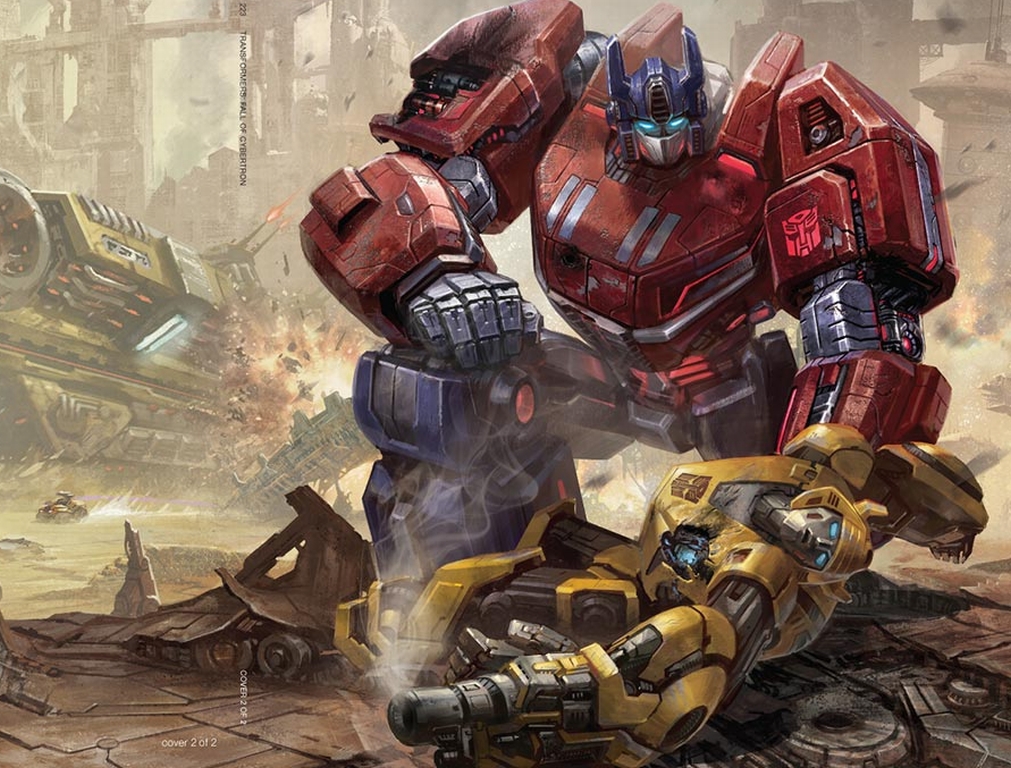
I think the best example of the improvement is in the first level, where (and I didn't like this initially) you are treated to a Bumblebee-centric tutorial, midway through the Nemesis' jacking and boarding of the Ark. Right off the bat it's obvious that High Moon has gotten a better idea for dynamic action sequences. Bumblebee gains control of his functions one by one in the tutorial, and wades through the war-torn battlezone, stopped by bad guys, and forcing you get to Optimus in time.

It's explosive. It's completely insane. It's perfect. High Moon has learned – or maybe just had the time and money to make – that the best way to convey war is to make things happen that are far bigger than you. Transformers named and nameless will die through the course of the game, because Cybertron is becoming a big mess of despair, death, and pain.

Let me apply context and say that no, Transformers has not jumped the shark and tried to convey war-is-hell drama through embarrassingly awful plot deaths. Nor has it tried to convey a serious story through characterization and development. Which seems like an odd departure since the trailers were setting up to do exactly that, but we can ignore the advertising for the moment, even if it was kind of awesome. It is, on the whole, still a cartoon about big robots.

But the story and presentation has grown up significantly – the characters are better fleshed out, all of their backstories and personalities make sense, and best of all, everyone has their own actions happening simultaneously while the story takes place. It's like a well put-together movie, worth a trillion more than Michael Bay's obnoxious military hardware wank-fest with teenagers running around acting relevant.

It's not like War for Cybertron, where you take control of one unit doing a thing while everyone else does fuck all. The intro chapter establishes that the Ark is under constant Decepticon assault, and it was put at risk by Grimlock's mysterious abandonment of his defense post. With Prime occupied, Jazz and Cliffjumper take off to investigate. Then, later, when Grimlock shows up, it explains everything, including how he got his dinosaur form on a planet with no dinosaurs, where he's been all that time, and the like.

The plot is incredibly cohesive in how it swaps between factions and characters, but you're never left wondering what the hell they're doing. It's established firmly why this new character is in control, and after some snappy dialogue, you get a strong sense of understanding of Cliffjumper and Jazz's relationship and personalities. And that's just what I can give you that doesn't spoil lategame events.

It's a testament to this that I say High Moon has really understood changes of pace. From the explosive tutorial, you control Prime as he rushes to keep the Ark safe from Decepticon assaults, and awakens Metroxplex, a transformer the size of a city. After one of the most satisfying sequences of melee attacks in action game history, the game downshifts, and you play as the duo investigating a Decepticon outpost. Cliffjumper cloaks and is small enough to fit into hidey-hole shafts, creating a new stealth sequence.

It's hard to put into words just how great it feels to go from an explosive action sequence, with Optimus Prime barreling through Decepticons by the truckloads, only to later quietly creep from baddie to baddie, executing City of Rust guards with a tap of the button, Tenchu: Stealth Assassins style. Once they start including rocket-launcher armed 'Cons with stealth-tracking scanners, it actually gets hard, too.

And just after that, Cliffjumper gets himself into a pickle and you swap off to Jazz, who is a mechanical Spider-Man with his wrist-mounted tether. After a few action sequences, the game opens up into a multi-tiered shootout platformer sequence and lets you zip from ledge to ledge, unloading sniper rifle rounds into enemies. And that's just the first few levels – Fall of Cybertron keeps shifting gears, giving you new people to play with and building towards something bigger. And by the time the ending comes, they've trained you how to do everything in the game thus far, which makes it all the more satisfying as it hops from objective to objective.

The presentation and music is what sets it the most apart – swelling orchestral pieces with bombastic drums, a reverbing bass, and intense latin chorus sets you up for exactly what you are in for.

The big issue with War for Cybertron's vehicle modes was, aside from the occasional moment, that there was no real reason to transform other than to move faster. Ordinarily, the inclusion of a sprint mode would kill any reason to change your mode, aside from having a different gun to fire. But Fall of Cybertron surprised me again by, instead of changing the game mechanics, just put you into different environments.

Cliffjumper, as mentioned, can go to car mode to slip into small tunnels. But when it's a Decepticon mission to sabotage a large carrier, you take control of first Vortex, who's working to destroy the bridge ahead of the carrier, and Swindle, who assaults the ground forces to destroy the tank's wheels. Vortex has to zip around from the air then to the ground and destroy defensive outposts. Then, Swindle fights Autobots, while constantly swapping between vehicle and robot mode to keep pace with the huge moving vehicle.

I'm not a fan of forgiving games just for having a good sequel, but it's really amazing that the developers learned so well how to present and deliver a game. Not just a generic shooter, but one that capitalizes on the strengths it has and stands apart due to the experience it delivers.

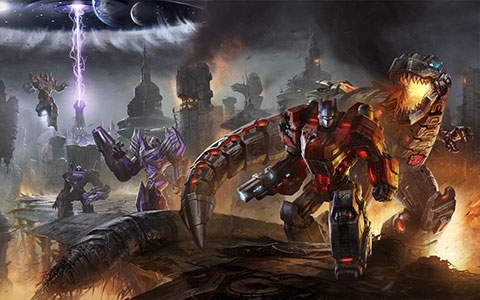
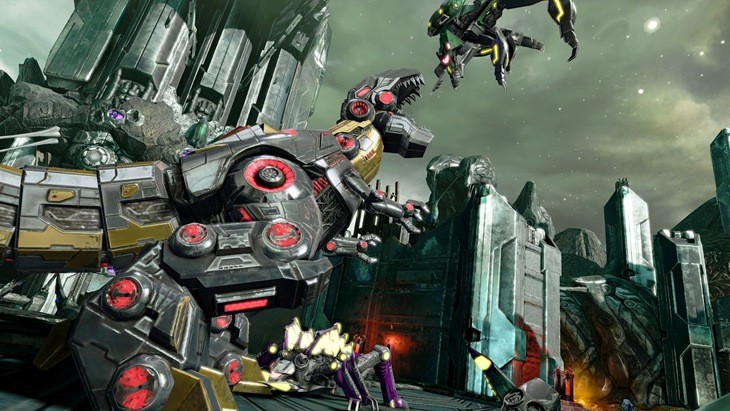
That's not even to mention how they managed to make the game look great. Cybertron, war ravaged and torn apart, shines and glows like a city with its dingy parts sticking out terribly. Cliffjumper and Jazz's exploration into the Sea of Rust evokes memories of the desert level from every shooter before it, but is mercifully short. And, after that, an organic squishy level takes place when they stumble on some of Shockwave's organic experiments in underground caves. Each level – and multiplayer map – is colorful and varied, with all sorts of red, blue, green, and purple. Even from the few screens I've collected here you can see how bright everything is.

There's a lot of good here, and even stuff I never touched on – there's more ammo, each gun feels more distinct and useful, and all the upgrades make the guns feel stronger in their attributes rather than just +10 damage. I've found the SMG and Megatron's cannon are some of the more destructive guns in the game, and limiting you to one conventional gun and one heavy means you need to be more careful on the shots you take with bigger guns. Sure, Megatron can one-shot half the baddies in the game, and the unique upgrade for it is amazing, but if you're a terrible shot, what gun are you going to switch to, your RPG? Your chaingun?

Further, the online is actually great. Multiplayer suffered from lack of balance, lack of customization, and the crummy health system. Most of those have been fixed, and the maps expanded, meaning everyone has a place. A Scientist jet has the advantage of a heal, air control, sentry turrets, pseudo-radar, and homing rockets, but their health is extremely low, and they only start with a few crummy guns. Infiltrators are basically spies, with absurd speeds, cloaking, and sniper rifles. Destroyers are Prime and Megatron wreckers with a hover ability and a ground slam, a force field, and big guns. Titans, as the name implies, are big, slow brutalizers with the whirlwind spin attack. Each class is exploitable. And, best yet, you can redeco any of them to be your favorite Transformer, or mod them to be weird Frankenstein versions of them combined with others. That's not even touching on Escalation.

It's not a perfect game. As I mentioned, there's not a lot of character development, which is unfortunate as I was hoping for a political fallout from the new Prime's controversial decision to leave their home. Further, some of the nicer touches from WfC are gone. The hard, mechanical way the Bots and Cons transformed into the turrets is sorely missed. The game also has an annoying habit of sticking you with a fragile Scientist character like Starscream or Vortex and send three shotgun-bearing Bulkhead-lookalike Autobots your way, sending you back to the loading screen once more.

But as far as video games? I can recommend it not just to fans of the franchise, not just to fans of shooters, but even to those who disliked War for Cybertron. It's not breaking any ground with story, but it's competently told and masterfully directed, and that's all I really needed from a robot shooter.